
 I used to think of scrolls as a quaint relic of the distant past, resurrected occasionally now for special occasions like a wedding ceremonies or graduations. When my drawings became more scroll-like, I looked to ancient Chinese and Japanese artwork for instruction and inspiration, but then I noticed that I was using scrolls everyday. When the codex surpassed the scroll as the ideal structure for reading materials, I doubt that anyone expected the scroll to make its triumphant return a thousand (plus) years later, but here we are, in an extraordinary technological era, and it is because of this very digital technology that the scroll has revived. When I make a call on my cell phone, I scroll down the list of names and numbers; when I play music on my iPod, I scroll (in a circle!) to find an artist or playlist; on the highway, scrolling signs will tell me if there’s heavy construction or an unexpected spill; when I put the TV volume on mute, closed-captioning automatically comes on, scrolling down with dialogue. That’s a lot, but there’s more; when I watch the news, I expect to see a ticker along the bottom of the screen, listing sports scores, stocks rising and falling, or news that’s just more interesting;
  there are video games called ‘side-scrollers’ that, yes, scroll from left to right as you play; and of course, you’ll have to scroll down to see all of my blogs on this page.
Some of the reasons for these scrolls are obvious – you can’t expect a highway worker to flip pages of a giant book telling you how many more miles you’ll be stuck in traffic. And scrolling around a circular pad on my iPod is just plain cool. But there are reasons why certain books and/or works of art should be created as a scroll rather than individual sheets of paper, or binding those sheets into a codex. I’ve been thinking more about it within the parameters of my own artwork, but let me preface the following by stating that these reasons were born out of irritation while flipping through the pages of a newly published book depicting an ancient Chinese scroll painting, where pages arbitrarily dissected images and entirely changed the viewing mode of the painting, creating a different experience than what I think was intended. Anyways, here are some of my reasons for making scrolls:
1.) Using a scroll removes any framing device, leaving the viewer to form his/her own, or to learn to see without frames
2.) The movement of viewing smoothly from one side to another can reinforce the narrative qualities of a series of images
3.) The scroll is better suited to represent life – a continuous line (or series of lines). This is why timelines are usually presented as single, long lines. Time doesn’t create chapters, WE do.
4.) It generates a more continuous flow – Kerouac knew this when he wrote his first draft of On The Road
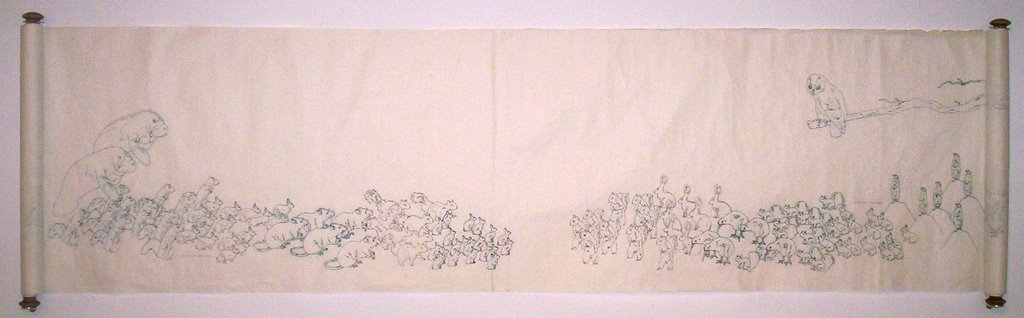 So, because the codex surpassed the scroll in its popularity and use, the scroll form has been overlooked as a useful format for a reading and viewing structure…until now. Although the codex serves its purpose, specifically to aid in indexical reading and ease of retrieval, scrolls serve a different purpose, and it seems that its usefulness has returned due to its integration with digital technology. However, I’d like to suggest that the scroll structure can be equally as valuable in physical form, and that maybe the best way to read your next book might not be flipping pages.
1 comment:
nice viewtiful joe. in a art blog.
Post a Comment